# 7 Signs Your Logo Needs Expert Vector Artwork Conversion Before Printing
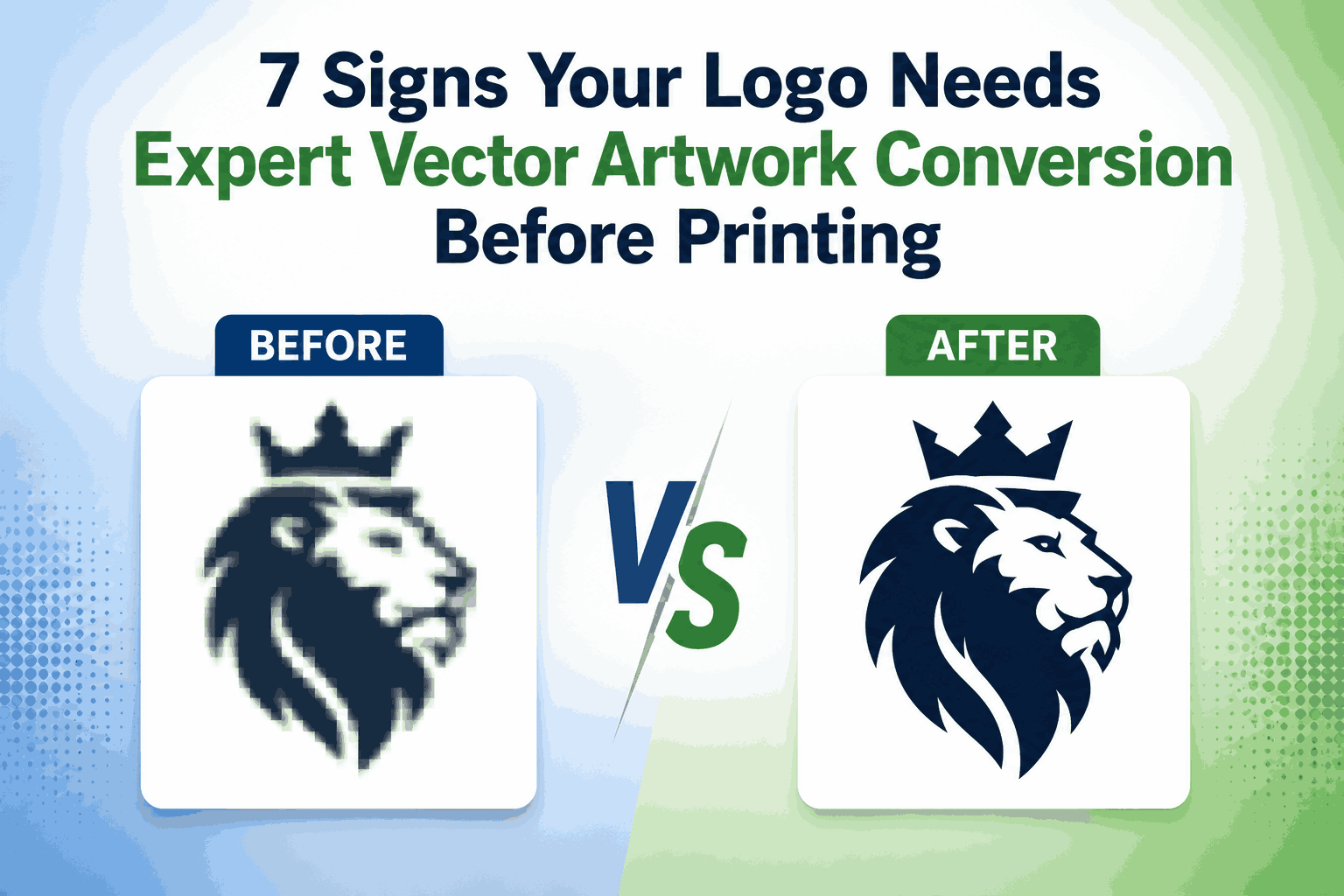
If your logo looks great on a screen but falls apart when printed, it may be time for [expert vector artwork conversion](https://idigitize.com/pages/vector-tracing). Many businesses unknowingly use low-quality logo files until they encounter printing problems, blurry graphics, or production delays.
The good news is that these issues are often preventable. By recognizing the warning signs early, you can ensure your logo remains sharp, professional, and ready for any print project, from business cards to billboards.
## Main Answer
Your logo likely needs expert vector artwork conversion if it becomes blurry when enlarged, exists only as a JPG or PNG file, was downloaded from a website, fails printer requirements, or shows quality issues across different marketing materials.
Professional vector conversion transforms low-quality or limited-use logo files into scalable artwork that can be printed at any size without losing clarity. This helps maintain consistent branding and reduces costly production issues.
## Detailed Explanation
### Why Printing Requires Vector Artwork
Many businesses receive their logo years ago and continue using the same file without knowing its limitations.
Common logo formats include:
* JPG
* JPEG
* PNG
* GIF
* Screenshots
* Social media downloads
These are raster images made of pixels. While they may look acceptable on digital platforms, printing often exposes their weaknesses.
Vector artwork uses mathematical paths instead of pixels. This allows logos to scale without losing sharp edges, clean details, or professional quality.
## 7 Signs Your Logo Needs Expert Vector Artwork Conversion
### 1. Your Logo Becomes Blurry When Enlarged
This is one of the most obvious warning signs.
A logo may look fine on:
* A website
* Email signature
* Social media profile
But when enlarged for:
* Banners
* Signs
* Vehicle graphics
* Trade show displays
the image may become fuzzy or pixelated.
#### Real-World Example
A small retail business used a Facebook profile logo for a storefront sign. The logo appeared sharp online but looked blurry and unprofessional when printed at a larger size.
Professional vector conversion solved the issue by recreating the logo in a scalable format.
### 2. You Only Have a JPG or PNG Version
Many businesses only have:
* JPG files
* PNG files
* Screenshots
These formats are useful for digital applications but are often unsuitable for professional printing.
If your logo files are limited to raster formats, creating a vector version can prevent future production challenges.
#### Quick Test
Zoom your logo to 500%.
If the edges become jagged or blurry, you are likely working with a raster image.
### 3. Printers Keep Asking for Vector Files
A common situation occurs when a printer requests:
* AI files
* EPS files
* SVG files
* Vector PDFs
If you cannot provide these formats, your logo may need professional vector conversion.
Many commercial printers prefer vector artwork because it:
* Produces cleaner output
* Supports large-format printing
* Improves color accuracy
* Reduces production errors
### 4. Your Logo Was Downloaded From a Website
This is surprisingly common.
Business owners often retrieve logos from:
* Company websites
* Social media accounts
* Old marketing materials
These versions are usually compressed and optimized for screen viewing rather than printing.
#### Why This Causes Problems
Website logos are often:
* Low resolution
* Compressed
* Missing original design layers
Even if they appear acceptable online, they rarely provide the quality needed for professional print production.
### 5. Fine Details Are Disappearing
Small design elements can suffer significantly when using low-quality artwork.
Examples include:
* Thin lines
* Small text
* Intricate icons
* Detailed illustrations
When details start disappearing or becoming unclear, it often means the logo file does not have enough quality for the intended print size.
Professional vector recreation helps preserve these elements more accurately.
### 6. Colors Look Inconsistent Across Materials
Have you noticed your logo appearing slightly different on:
* Brochures
* Packaging
* Signage
* Promotional products
Poor-quality artwork can contribute to inconsistent reproduction.
While color management involves several factors, vector artwork provides cleaner and more reliable files that help designers and printers maintain consistency.
#### Example
A company using multiple versions of its logo experienced different color appearances across marketing materials. After creating a master vector file, the branding became much more consistent.
### 7. You Are Planning Large-Scale Marketing Projects
Even if your logo looks acceptable today, upcoming projects may reveal quality limitations.
Large-scale applications often include:
* Billboards
* Trade show displays
* Building signage
* Vehicle wraps
* Event backdrops
These projects require artwork that can scale dramatically without losing detail.
Creating a professional vector version before production helps avoid last-minute problems and expensive redesigns.
## Step-by-Step Guide: What to Do If Your Logo Needs Conversion
### Step 1: Locate Your Existing Files
Gather all available versions of your logo, including:
* PNG files
* JPG files
* PDFs
* Old design files
Even low-quality files can help a designer recreate the artwork accurately.
### Step 2: Identify Future Usage
Consider where the logo will appear:
* Business cards
* Packaging
* Apparel
* Signage
* Promotional products
Understanding future applications helps determine the level of detail required.
### Step 3: Use Professional Vector Conversion
An experienced designer manually recreates:
* Shapes
* Typography
* Curves
* Colors
This often delivers significantly better results than automatic tracing software.
### Step 4: Request Multiple Formats
A complete logo package typically includes:
* AI
* EPS
* SVG
* PDF
These formats support both digital and print workflows.
### Step 5: Store Master Files Securely
Keep original vector files in:
* Cloud storage
* Brand asset libraries
* Company backups
This prevents future file-loss issues.
## Examples and Practical Use Cases
### Example 1: Restaurant Menu Reprint
A restaurant needed updated menus and promotional banners. The only available logo was a small JPEG from years ago.
After vector conversion:
* Menus printed clearly
* Banners appeared professional
* Branding became consistent
### Example 2: Trade Show Booth Graphics
An exhibitor planned a large event backdrop. The supplied PNG logo looked pixelated when scaled.
Professional vector artwork allowed the logo to print sharply across the entire display.
### Example 3: Promotional Merchandise
A company ordered:
* T-shirts
* Caps
* Pens
* Tote bags
The vector logo helped ensure consistent reproduction across all products.
## Pros and Cons of Expert Vector Artwork Conversion
### Pros
#### Improved Print Quality
Expert vector conversion produces cleaner and sharper output.
#### Unlimited Scalability
Vector artwork works for both small and large formats.
#### Better Brand Consistency
It helps maintain a uniform appearance across different materials.
#### Easier Future Editing
Designers can make future adjustments more easily.
#### Printer-Friendly Formats
Vector files meet common commercial printing requirements.
### Cons
#### Initial Design Cost
Professional conversion requires skilled work.
#### Time Investment
Complex logos may take longer to recreate accurately.
#### Quality Depends on Source Material
Very poor originals may require additional reconstruction.
## Common Mistakes to Avoid
### Waiting Until Production Day
Many businesses discover file problems only after submitting artwork to a printer.
### Using Screenshots as Official Logos
Screenshots are rarely suitable for professional printing.
### Assuming All PDFs Are Vector Files
Some PDFs contain raster images rather than true vector artwork. Always verify the file type before production.
### Relying Solely on Auto-Tracing Software
Automatic tracing often introduces:
* Uneven curves
* Extra anchor points
* Distorted lettering
Manual refinement is usually necessary.
### Losing Original Vector Files
Without backups, businesses may need to recreate artwork repeatedly.
## Expert Tips
### Create a Master Brand Folder
Store approved logo files in one secure location.
### Keep Multiple Logo Versions
Maintain different versions, such as:
* Full color
* Black and white
* Single color
* Reverse logo versions
### Test Before Large Print Runs
Request proofs whenever possible before final production.
### Think Long-Term
Vector artwork is an investment that supports future marketing projects for years.
### Work With Experienced Designers
Professional recreation typically produces more accurate and reliable results than automated solutions.
## Conclusion
A logo is often the most recognizable part of a brand, but many businesses unknowingly rely on low-quality files that create problems during printing. If your logo becomes blurry when enlarged, exists only as a JPG or PNG, fails printer requirements, or loses detail across marketing materials, professional vector artwork conversion is worth considering.
By addressing these issues before production begins, you can avoid delays, improve print quality, maintain brand consistency, and ensure your logo performs well across every marketing channel.
**Note:** Printing specifications, file requirements, and production standards vary between vendors. Always confirm current requirements with your printer or production partner before placing an order.
## FAQs
### 1. How can I tell if my logo is already a vector file?
Vector files are typically saved as AI, EPS, SVG, or certain PDF formats. If the logo can be enlarged without becoming blurry, it is likely vector-based.
### 2. Why do printers prefer vector logos?
Vector artwork provides cleaner edges, better scalability, and more accurate reproduction for commercial printing processes.
### 3. Can a low-resolution logo be converted into a vector file?
Yes. Professional designers can manually recreate many low-resolution logos as scalable vector artwork.
### 4. Is automatic tracing good enough for logo conversion?
For simple artwork, it may work partially, but manual vector conversion usually produces cleaner and more accurate results.
### 5. When should I convert my logo to vector format?
Ideally, before creating signage, packaging, promotional products, apparel, or any large-format printed materials. Having a vector logo early helps avoid future production issues.